

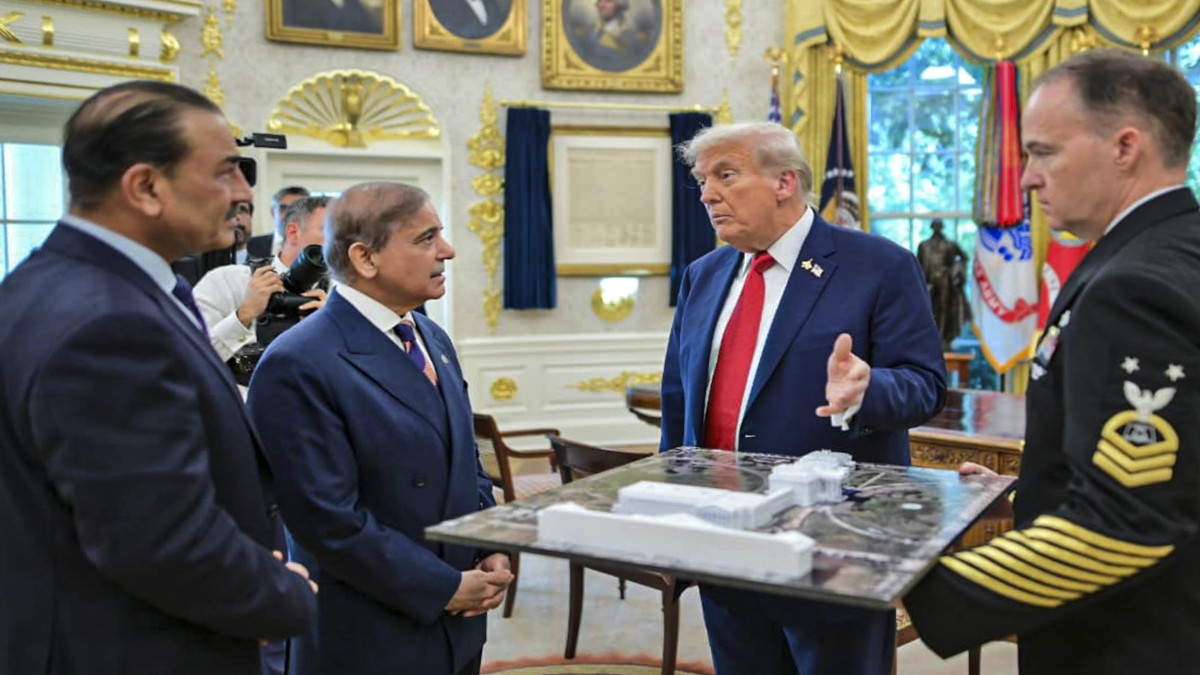
On September 30, US President Donald Trump declared that Pakistan’s Prime Minister Shehbaz Sharif and Field Marshal Asim Munir fully endorse his plan to resolve the Gaza conflict. Trump made these remarks during a joint press conference with Israeli Prime Minister Benjamin Netanyahu at the White House.
Trump described his initiative as ‘Comprehensive Plan to End the Gaza Conflict,’ emphasizing that many world leaders, including Sharif and Munir, actively participated in negotiations towards this goal. He stated, ‘This afternoon after extensive consultation with our friends and partners throughout the region, I’m formally releasing our principles for peace, which people have really liked.’
He acknowledged the cooperation from Arab and Muslim nations as crucial, thanking leaders like Saudi King Salman, UAE President Mohammed bin Zayed Al Nahyan, and Qatar’s Emir. Trump noted how their input shaped the proposal, saying, ‘These leaders were totally involved…giving us ideas, things they can live with, things they can’t live with.’
In reference to the collaborative efforts, Trump highlighted the involvement of Jordan’s King Abdullah II, Turkish President Recep Tayyip Erdoğan, and Indonesia’s Prabowo Subianto. He expressed appreciation for the commitment of Pakistan’s leaders from the beginning of the discussions.
According to Trump, a recent statement from Prime Minister Sharif and Field Marshal Munir confirmed their 100% support for the plan. He noted, ‘Just as I was walking out, they said, ‘Sir, you have a big notice from the prime minister of Pakistan and from the field marshal that they back this 100 percent.’
The plan entailed designating Gaza as a de-radicalized, terror-free zone, allowing for redevelopment initiatives that would not pose a threat to neighboring regions. Trump asserted that if both conflicting parties—Israel and Hamas—agree to this proposal, the war would cease immediately.
Key points of the proposal include the immediate suspension of military operations, the establishment of a timeline for a total withdrawal of Israeli forces, and mechanisms for the return of hostages, including a stipulated timeframe for the return of all hostages, dead or alive, within 72 hours.
Once hostages return, Israel commits to releasing 250 prisoners serving life sentences and 1700 Palestinians detained after October 7, 2023. Furthermore, for each Israeli hostage whose remains are released, Israel will return the remains of 15 deceased Gazans.
After Trump’s announcement, foreign ministers from several nations, including Saudi Arabia, Jordan, UAE, Indonesia, Pakistan, Türkiye, Qatar, and Egypt, expressed their support for Trump’s leadership and efforts to end the conflict. They released a joint statement backing the proposal to rebuild Gaza, address humanitarian needs, and secure a peace strategy that prevents Palestinian displacement.
In their statement, ministers affirmed their commitment to working collaboratively with the US and other parties involved to finalize the agreement. They outlined a vision aimed at ensuring peace, security, and stability for the region, anchored in a comprehensive deal ensuring unrestricted humanitarian aid to Gaza and advocating for the two-state solution.
Sharif, who was in New York for the high-level 80th session of the United Nations General Assembly, met Trump in the White House prior to the announcement. Trump’s summer meeting with Munir also indicated a growing diplomatic engagement between the US and Pakistan.
This strategic communication aligns with Trump’s broader foreign policy goals, where collaboration from key regional players remains paramount. The initiative carries the weight of potential ramifications for not just Gaza, but the geopolitical landscape affecting Pakistan and the broader Middle East.