

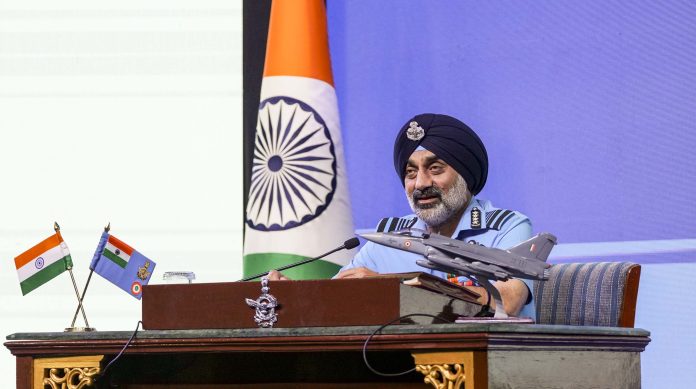
In a decisive military operation, Indian Air Force (IAF) Chief, Air Chief Marshal Amar Preet Singh, announced on Friday that the IAF successfully destroyed 4 to 5 Pakistani fighter jets, likely F-16s, during Operation Sindoor. This operation symbolizes a critical moment in India’s aerial defense capabilities.
The operation occurred on the same day in New Delhi, where Singh addressed the media, detailing the precision strikes conducted on multiple Pakistani airbases. He confirmed extensive damage was inflicted on key military infrastructure, including radars, command centres, runways, hangars, and a surface-to-air missile (SAM) system.
“We struck a large number of their airfields and installations…radars at four places, command centres at two locations, two runways, and three hangars were destroyed,” Singh stated. He also pointed out that evidence confirmed one C-130 aircraft being hit along with at least 4–5 fighters likely undergoing maintenance.
Singh highlighted that the IAF employed its newly procured long-range SAMs, effectively neutralizing any operational capacity of the Pakistan Air Force within its own territory during the operation. This operation also achieved a historic milestone, marking the longest successful missile strike of over 300 kilometers, which severely crippled Pakistan’s aerial response capabilities.
Calling Operation Sindoor a decisive and time-bound success, Singh explained, “This was a war started with a clear objective and concluded swiftly once our goals were achieved. Unlike prolonged global conflicts, India demonstrated that clarity and precision can force an adversary to ask for a ceasefire.”
He stressed that the outcomes of this operation provide a crucial lesson for the world, particularly against the backdrop of ongoing international conflicts that seem to show no signs of resolution.
The Air Chief Marshal’s statements reaffirm India’s commitment to ensuring national security and maintaining air superiority. Singh concluded his briefing by emphasizing that such operations not only protect India but also serve as important signals to potential adversaries regarding India’s advanced military capabilities.