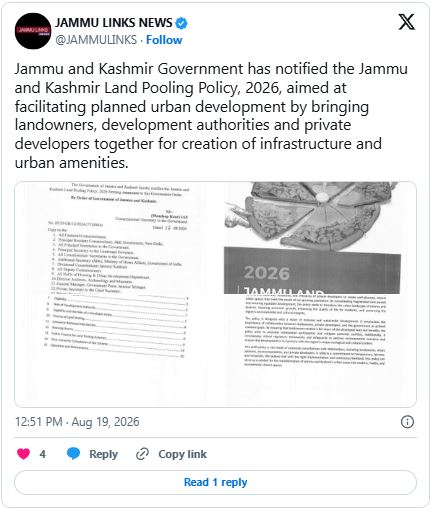

The Government of Jammu and Kashmir (J&K) recently notified the Land Pooling Policy for 2026, mandating a 70% consent from landowners for efficient urban development. This policy aims to facilitate systematic development by involving landowners directly in the process.
Notified through Government Order No. 173-JK(HUD) dated August 17, 2026, the policy’s objective focuses on enhancing planned urban infrastructure, ensuring that landowners interested in collaboration become recognized partners in development projects.
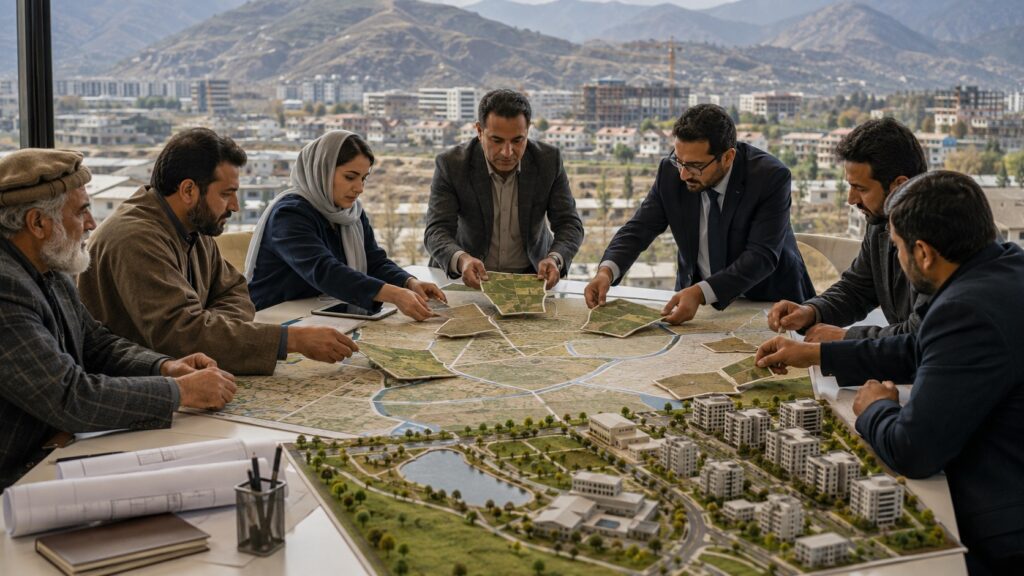
The new regulation allows Developer Entities or consortiums wishing to develop areas to register their interest. A land pooling scheme can only be initiated when at least 70% of landowners in any contiguous area express their willingness to participate in this process.
Significantly, the policy states that the Developer Entity can retain up to 60% of the pooled land, while the remaining 40% will go to the Development Authority. This area will be utilized for developing essential city infrastructure, recreational facilities, and public assets as per the existing Master Plan and Zonal Development Plans.
This innovative approach permits the Developer Entities to utilize the available land for constructing residential, commercial, institutional, and infrastructural facilities, ensuring a balanced development in neighborhoods with adequate public amenities.
The policy also introduces a flexible mechanism for land redistribution among participating owners. This may occur through developed land, built-up spaces, or agreed forms of fair exchange, promoting equity among stakeholders.
To execute this policy effectively, the concerned Development Authority has been entrusted with crucial responsibilities, including the preparation and planning of proposals, managing infrastructure, and ensuring smooth coordination amongst various agencies providing essential services like water supply, electricity, and transportation.
Moreover, a two-tier grievance redressal mechanism will address disputes during implementation. This system ensures that complaints directed at the Grievance Redressal Committee are resolved within 30 days, with an optional appeal to a higher committee overseen by the Vice Chairman or Chief Executive Officer of the Development Authority.
The push towards transparency continues with a proposed online system for all land pooling operations, increasing efficiency across applications, registrations, and monitoring of the development process. This initiative is integral in ensuring an accountable environment for the stakeholders involved.
Importantly, the policy prescribes strict timelines for executing different scheme stages. Developers are given an initial interval of up to 60 days for consortium formation, extendable by another 30 days. Furthermore, submission of the land pooling scheme to authorities must occur within six months of consortium formation, ensuring a responsive timeline for development.
Finally, the policy outlines that maintenance of developed areas under these schemes will fall under the purview of the Developer Entity or consortium until the Urban Local Body can manage infrastructure after formal completion and handover, according to pre-defined standards.